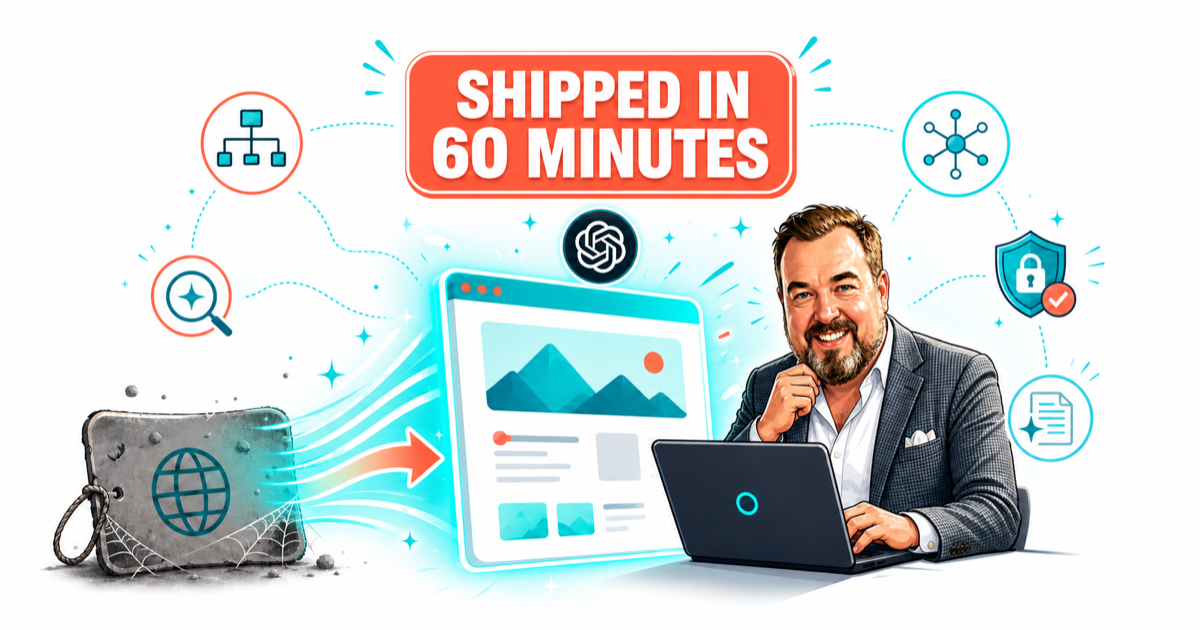
I had been redirecting chrisbreikss.com to my company website for years. It was not doing anything wrong. It just was not doing anything useful for me either.
As I spend more time thinking about AI visibility, that started to feel like a missed opportunity. A personal site gives people, search engines, and AI systems one place to understand who you are, what you have built, and how the pieces fit together.
Apparently I am becoming the AI visibility guy. It is not a title I gave myself, but it is increasingly the work I do: helping businesses make their public story clear enough for AI systems to understand and represent accurately.
Then I saw a post about ChatGPT Sites while scrolling Instagram. I had been spending most of my AI time in Claude and had even let my ChatGPT subscription lapse. The idea that I could describe a site, have it built, and have it hosted from the same conversation sounded implausible enough that I had to try it.
What shipped in an afternoon
The initial website was live in under an hour. Then I dictated the story of what happened using Wispr Flow, at well over 130 words per minute, and worked back and forth with ChatGPT to turn it into the page you are reading.
| What changed | What shipped |
|---|---|
| Personal site | A multi-page personal site with a clear narrative, Major Tom, Rivetline, selected media, and contact paths. |
| Technical foundation | Custom domain, DNS, SSL, Google Tag Manager, sitemap, robots.txt, canonical tags, Open Graph metadata, and JSON-LD. |
| AI context | Person, Organization, WebSite, WebPage, BlogPosting, and FAQ structured data, plus llms.txt. |
| First marketable asset | An Insight, a featured image, a comparison table, an FAQ, social-preview metadata, and a cross-link to the Rivetline AI Glazing post. |
That is the interesting part to me. The site was not the end product. It became the platform for an article, an image, a social post, and a conversation about what this kind of workflow means. The first version went from idea to a shareable asset in the same afternoon.
What I asked it to build
I did not ask for a marketing funnel. I wanted a personal site that could be a stable reference point: clear about my role as a founding partner at Major Tom, clear about Rivetline as my current specialist practice, and clear about the work I do around AI visibility.
ChatGPT used the background notes and media links I already had. The first version was too heavy on Rivetline, so I pushed it toward a better reflection of my career. That mattered. A personal site should not read like a disguised agency landing page.
The funny part: I had to remind ChatGPT what it could do
Its first instinct was to suggest other hosting providers. I kept saying that I thought it could host the site itself. I eventually linked it to its own documentation and asked it to use the Sites capability directly.
That happened more than once. It was funny, but also useful context. The tool is new enough that knowing the feature exists is part of using it well. Once we were on the right path, it created a private preview, prepared the deployment, and gave me the exact DNS records to enter at GoDaddy.
What happened after the design was done
The part that surprised me was how much of the ordinary web work could happen in the same conversation. I asked about Google Tag Manager. Then I asked about schema, a sitemap, robots.txt, and social-preview metadata. Those were added as real site files and page markup, not left as a future checklist.
When I asked about a custom domain, it created the domain connection, gave me the records, and waited for me to save them at GoDaddy. The domain and SSL certificate activated shortly after. I also asked for an llms.txt file, not because it is a magic AI visibility switch, but because it is a clean, factual guide to the site for tools that choose to read it.
How this compares with the usual routes
This is where I would be careful. A conversational site builder does not make WordPress, a competent developer, or a proper content system obsolete. It changes the economics of getting a small, well-structured site out of your head and onto a domain.
| Factor | Traditional custom build | WordPress or a CMS | ChatGPT Sites |
|---|---|---|---|
| Best for | Complex, highly tailored digital products | Ongoing editorial publishing and larger sites | Personal sites, campaign pages, portfolios, and lightweight publishing |
| Starting speed | Usually measured in weeks | Fast after setup, with configuration time up front | Fast for a defined, contained first version |
| Publishing workflow | Depends on the build and the team | Built for editors and repeat publishing | Best when you are comfortable making changes conversationally or through the site source |
| Technical control | Highest, with the right development team | High, with themes, plugins, and maintenance | Enough for a focused site, with fewer moving parts |
| Trade-off | More planning, time, and cost | More administration and plugin decisions | Not the answer for every complex workflow |
What it cannot do for you
It can ship a credible first version quickly. It cannot decide your positioning, manufacture proof, or make a weak story interesting. It also does not remove the need to review the details. I corrected the emphasis, checked the claims, and kept the contact path simple with an email link rather than a form.
For a company publishing daily, supporting multiple authors, running commerce, or integrating a pile of business systems, I would still choose the platform deliberately. That may be WordPress, Shopify, a headless CMS, or a custom build. The right answer depends on what the site needs to do after launch.
The feature that won me back
I ran into a usage limit while building the site, so I reactivated my ChatGPT subscription. It was a small but telling moment. I had cancelled because I was spending so much time in Claude. This feature brought me back.
I like that these companies are pushing each other. The winner is not the model with the most impressive demo. It is the one that helps you take a real project from an idea to something live, useful, and worth sharing.
Frequently asked questions
What are ChatGPT Sites?
ChatGPT Sites is the site-building and hosting capability I used for this project. It let me work conversationally from a local project, create a private preview, deploy the site, and connect my own domain.
Can ChatGPT Sites replace WordPress?
ChatGPT Sites can be a strong fit for a fast brochure site, campaign page, portfolio, or lightweight publication. WordPress or another CMS remains the better fit when a team needs frequent editorial publishing, complex workflows, many contributors, or a broad plugin ecosystem.
Can I connect a GoDaddy domain to a ChatGPT Site?
Yes. I kept my domain at GoDaddy, replaced the old redirect with the DNS records provided by ChatGPT Sites, and waited for the domain and SSL certificate to activate.
Is a personal website useful for AI visibility?
A personal website gives you one canonical place to state your background, roles, work, and supporting evidence. It does not guarantee citations in AI answers, but it makes the underlying entity and its relationships easier to verify.
Do I still need schema, a sitemap, and analytics?
Yes. The site includes structured data, a sitemap, robots.txt, and Google Tag Manager. They are ordinary web fundamentals, and they still matter when the goal includes search visibility and clear machine-readable context.
How was this article created?
I dictated the outline and edits using Wispr Flow, then worked conversationally with ChatGPT to draft, structure, format, add metadata, create an illustration, and publish the post. I reviewed the copy and made the editorial decisions.
How much did it cost to build this site?
The domain was already mine, and I reactivated my ChatGPT subscription during the build. Product plans and availability can change, so I would treat the result as a current field test rather than a permanent pricing promise.
Bottom line
I turned an old dormant domain into a working personal website in about an hour because the distance between a clear idea and a deployed site is now much shorter than it used to be.
That does not mean every website should be built this way. It does mean you can test a personal brand, a new campaign, or a timely idea without treating the first version like a six-week production.
If you are thinking about how your business is represented in AI search, start with the basics: a clear entity, consistent facts, useful evidence, and pages people can verify. The technology is moving quickly. The underlying work is still making the story true and easy to understand.
Rivetline is a focused practice for AI visibility and digital growth. If you want a second set of eyes on how your business appears in AI search, start with the AI Search Grader.
Back to Insights